Loading...


A Piece of Dresden History: The Motif of Our 2026 Finisher Medal
“It is probably the most civilian military museum in the world, thoroughly anti-militarist – with no trace of glorifying war.”
Thomas Schmid, “Ein Keil ohne Donner”, DIE WELT, 8 October 2011
Anyone who crosses the finish line of the 26th DRESDEN MARATHON at the Heinz-Steyer-Stadion takes home more than just the memory of 5, 10, 21.1 or 42.195 kilometres through Dresden. Every year, our finisher medal also tells a small piece of our city’s history.
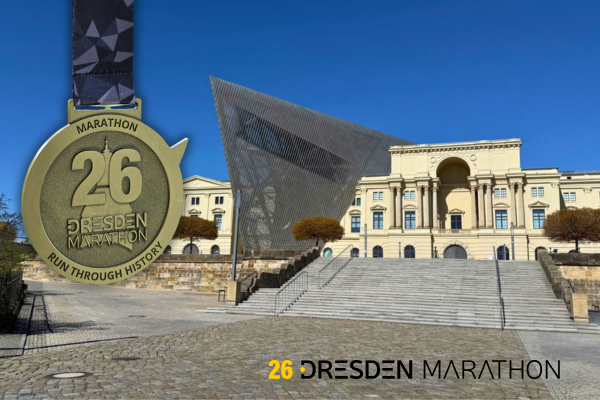
In keeping with our motto “Run Through History”, each year we put the spotlight on a special Dresden landmark. In 2026, we have chosen a building that connects the past and present in an extraordinary way: the Bundeswehr Museum of Military History.
A building with many stories
The museum building as we know it today was completed in 1876/77 as the main arsenal building of Dresden’s Albertstadt district. Its history stretches from its use as an armoury through various military history museums to today’s Bundeswehr Museum of Military History. Since its comprehensive redesign, the museum has seen itself as more than simply a place where military history is displayed. Instead, the focus is on the causes, forms and consequences of war and military violence, as well as their impact on people and society.
The museum aims to examine history from different perspectives, question established viewpoints and encourage reflection on the past, present and future.
This approach is particularly visible from the outside.
When modern architecture breaks through history
The historic 19th-century arsenal building is intersected by a striking wedge of glass, steel and concrete that can be seen from afar. This distinctive extension was designed by internationally renowned architect Daniel Libeskind. Following the reconstruction, the redesigned museum opened in 2011.
The wedge is far more than an architectural eye-catcher.
It deliberately breaks through the symmetry and enclosed form of the historic building and symbolises a break with conventional perspectives on military history. Its sloping walls challenge spatial conventions and open up new perspectives – reflecting the museum’s aim not simply to tell history chronologically, but to examine it critically and from different points of view.
The connection to Dresden is also direct: the wedge’s line of sight references the destruction of the city in February 1945. According to the museum, its angle of 40.1 degrees traces the funnel of destruction that extended across Dresden’s city centre at the time.
In this way, two approaches to viewing history come together directly within the building: the historic arsenal represents the traditional, chronological narrative of history. Libeskind’s wedge breaks through this order and encourages visitors to question familiar perspectives.
Why this motif belongs on our medal
It is precisely this connection that particularly appealed to us when selecting our medal motif for 2026.
There is a reason why the DRESDEN MARATHON carries the history of the city in its “Run Through History” claim. Our course passes places where Dresden’s history becomes visible – from the world-famous landmarks of the historic Old Town to buildings and neighbourhoods that tell very different chapters of the city’s story.
Our finisher medals embrace this idea as well. Every year, we select a special Dresden building as our motif, making another piece of the city’s history part of the DRESDEN MARATHON.
In 2026, our choice is the Museum of Military History because hardly any other building in Dresden connects past and present so clearly through its architecture. It preserves history while at the same time engaging critically with it, showing that history is always also a question of perspective.
For us, this reflects a city like Dresden – a city whose history has been shaped by splendour and destruction, by ruptures, change and new beginnings. Because anyone running through Dresden during the DRESDEN MARATHON does not simply pass beautiful buildings. They run through a city full of stories.
Your piece of Dresden at the finish line
On 25 October, the Museum of Military History will therefore become a very special part of the 26th DRESDEN MARATHON.
After the final metres and your finish at the Heinz-Steyer-Stadion, your finisher medal will be waiting for you – and with it another piece of Dresden’s history that will remind you of your run through our city for a long time to come.






At a Glance
Interesting Posts